
 by
Christian Fischer
by
Christian Fischer
Artificial intelligence has changed the speed at which marketing teams can produce visual ideas. Campaign concepts can now be explored in minutes, multiple versions can be created almost instantly, and designers can test directions that once required far more manual effort. For organizations under constant pressure to publish more content across more channels, this is a substantial advantage.
But the rapid expansion of AI-generated imagery has also exposed an important distinction. A visual can be impressive, relevant and technically sophisticated without necessarily being ready for commercial deployment. Once an image moves beyond experimentation and becomes part of a real campaign, additional questions come into play: Can it be used with confidence? Does it fit the brand? Can it be adapted across formats? Is its origin sufficiently clear? Will it work consistently alongside dozens of other assets?
As visual creation becomes easier, these questions are becoming more important. The value of an image is increasingly determined not only by how quickly it can be created, but by how effectively it can enter a professional marketing workflow.
For many years, marketing teams struggled primarily with production capacity. Creating enough imagery for campaigns could require photography, design, post-production, location planning, models and extensive coordination. Even relatively modest campaigns consumed significant time before a usable library of assets was available.
Stock media reduced part of this burden by giving brands access to professional content without requiring a dedicated production every time. Generative AI has now gone much further, allowing teams to produce concepts, variations and visual directions at unprecedented speed.

The result is a reversal of the old problem. In many cases, companies no longer suffer from a shortage of visual options. They suffer from an excess of them.
A creative team can generate dozens of concepts for a campaign in the time it once took to prepare a single draft. That abundance creates a new challenge: choosing which assets deserve to move forward. The more options a team has, the more important evaluation, curation and governance become.
Internal experimentation is forgiving. A concept image only needs to communicate an idea clearly enough for a team to understand it. It can be imperfect, temporary or unsuitable for final publication.
Commercial campaigns operate under different conditions.
A visual used publicly may appear across advertising networks, social platforms, corporate websites, sales materials and regional campaigns. It can remain visible for months or even years. The organization therefore needs more than aesthetic quality.
Before an asset enters production, teams may need to assess several factors:
These considerations are not arguments against AI-generated content. They simply illustrate why visual production and commercial deployment should not be treated as the same thing.
The ability to create quickly is valuable. The ability to deploy confidently is equally important.
Creative efficiency used to be discussed mainly in terms of production time. If an image could be created in one hour instead of one day, the process was clearly more efficient.
AI complicates that calculation.
A team might now generate fifty possible campaign images in a very short period, but the real cost emerges later if those assets require extensive review, corrections, reformatting or replacement. High output does not automatically mean high efficiency.
A more useful definition of creative efficiency considers the entire path from concept to deployment.
The strongest workflow is not necessarily the one that creates the largest number of assets. It is the one that gets suitable assets into market with the least unnecessary friction.
This is one reason professional stock platforms continue to matter. Services such as Shutterstock provide large collections of photography, illustrations, vectors and video created for professional use. That gives marketing teams access to source material that can move into a commercial workflow more directly, while AI can be used to accelerate adaptation and experimentation around it.


Exclusive: 15% off all standard subscriptions and packages from Shutterstock!
Get 15% off all standard subscriptions and packages from Shutterstock now!
Shutterstock: 15% Off Video Packs and Subscriptions
Enjoy a 15% discount on any video subscription or video pack!
The rise of generative AI has often been framed as a direct challenge to stock photography. If a marketer can generate a custom visual on demand, why search for one that already exists?
That comparison overlooks how real creative teams work.
Marketing production increasingly combines several sources. A campaign might use generated concepts during the planning stage, professional photography for key brand visuals, stock content for supporting assets and AI-assisted editing to create multiple formats.
This blended approach reflects the strengths of each method.
AI is particularly effective when teams need speed, iteration and experimentation. Professional stock content provides high-quality source material that already exists in a structured commercial environment.
The result is not a choice between old and new. It is a production model in which the two can strengthen each other.
The role of stock content itself is also changing.
Traditionally, a stock image was frequently treated as the final visual. A marketer selected an image, licensed it, added text or branding and published it.
Modern production is far more flexible.
A single professionally produced image can now become the starting point for an entire family of assets. It can be reframed for social media, adapted for mobile, integrated into video, combined with illustration or used as the visual foundation for several different campaign formats.
AI-assisted editing expands this potential further.
Instead of asking whether an image is already perfect for the final placement, teams can ask whether it offers the right subject, mood and visual quality to serve as a foundation.
That shift gives existing content a longer and more productive life.
The speed of generative AI has made another issue more visible: content provenance.
As visual material increasingly comes from multiple sources, organizations need clearer internal processes for understanding where assets originated and how they can be used.
This matters particularly at scale.
A large company may operate with internal creative teams, freelancers, agencies, AI tools and stock platforms at the same time. A single campaign can contain hundreds of individual assets that move through several approval stages.
Without clear sourcing, even simple questions can become difficult later.
Where did this image come from? Which version was approved? What conditions apply to its use? Can it be reused in another market?
Established stock platforms such as Shutterstock have long been structured around sourcing and licensing, which gives them a useful position in increasingly complex content ecosystems.

AI has lowered the cost of variation, but unlimited variation can create a branding problem.
A marketing team can produce a large number of attractive images that do not feel related to one another. Differences in lighting, composition, realism, color and visual tone can accumulate quickly.
Individually, each image may work. Collectively, they may weaken the brand.
Visual identity depends on repetition. Brands become recognizable because audiences repeatedly encounter similar creative signals: particular colors, types of photography, framing, environments and emotional tones.
This makes curated source material increasingly useful. Rather than generating every asset independently, teams can establish a visual foundation and use AI to create adaptations that remain within those boundaries. AI then becomes a tool for scaling consistency rather than increasing fragmentation.

The growth of digital channels has also increased the number of jobs a single campaign visual may need to perform.
One concept may need to appear as:
These formats are not interchangeable.
A visual that works well in a wide desktop environment may fail completely in a vertical mobile placement. Text requirements change. Crops change. Focal points change.
This creates enormous value in assets that can be adapted efficiently.
High-quality stock content gives teams a strong base from which to build. AI-assisted tools can then help extend that content into the numerous formats required by modern campaigns.
Performance advertising introduces yet another challenge: creative fatigue.
Even successful ads can lose effectiveness when audiences see the same imagery repeatedly. Marketing teams therefore need a steady supply of fresh creative without constantly rebuilding the entire campaign.
The answer is often controlled variation.
A team can preserve the underlying visual direction while changing images, crops, backgrounds or subject placement. This keeps the campaign recognizable while providing audiences with something new.
Professional stock libraries are particularly useful in this context because they allow marketers to identify groups of related images rather than relying on a single isolated asset.
AI can then help create a wider range of executions from that material.
The benefit is not simply more content. It is more content that still feels connected.
Global brands face an additional production problem: localization.
A campaign may need to communicate the same strategic message in several countries while using different people, settings or cultural cues. What feels authentic in one market may appear unfamiliar or inappropriate in another.
Creating dedicated photography for every country can be costly. Generating each market entirely independently can create inconsistency.
Professional stock libraries offer a practical middle ground.
A global marketing team can source imagery suited to specific regions while maintaining a broader visual style. Platforms such as Shutterstock are especially useful in this environment because large catalogues cover a wide range of demographics, industries, locations and lifestyles.
AI-assisted editing can then help adapt those assets further for local channels and formats.
This modular approach makes it possible to localize without rebuilding the campaign from the beginning.
AI can produce alternatives extremely quickly, but the presence of more options does not eliminate the need for judgment.
Someone still has to decide which visual communicates the campaign idea best. Someone must determine whether it feels credible, relevant and aligned with the brand. Someone must choose which variations are worth testing and which should be rejected.
These are not purely technical decisions.
Designers, art directors and marketers contribute context, taste and strategic understanding that automated production alone cannot provide.
AI may therefore shift creative work toward higher-value decisions. Instead of spending hours on repetitive production, teams can devote more attention to selection, refinement and direction.
The technology increases the number of possibilities. Human creativity determines which possibilities matter.
The rapid improvement of synthetic imagery has not removed the value of professional photography.
Real photography still offers specific advantages in areas where authenticity matters. Travel, hospitality, food, lifestyle, corporate communication, product marketing and editorial-style campaigns often benefit from real locations, deliberate lighting and genuine moments.
Professional photographers also make choices that extend beyond the subject itself. Composition, timing, framing and environmental detail all contribute to the final result.
Stock libraries provide access to a vast range of professionally produced photos and images. Instead of commissioning every production independently, brands can access existing high-quality material and then use modern tools to extend its usefulness.
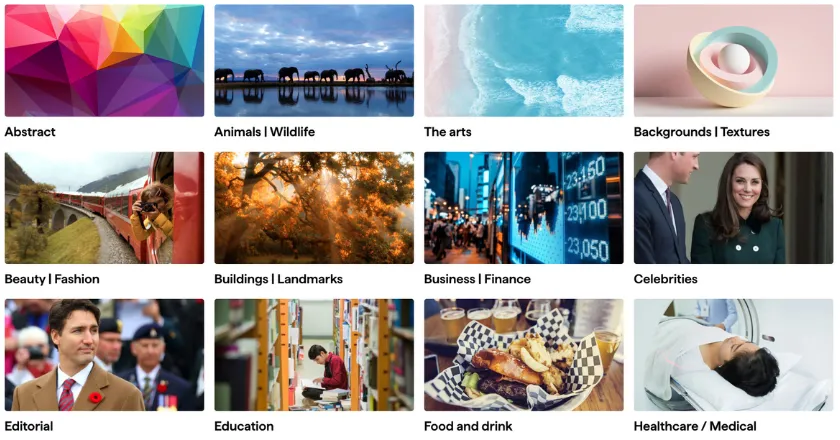
AI can therefore increase the flexibility of professional imagery rather than simply compete with it.
Creative culture often associates originality with starting from nothing, but commercial marketing has different priorities.
The final asset is judged on whether it communicates clearly, fits the brand and supports the campaign objective. The audience does not know — or care — whether the image began as a stock photograph, an original shoot, a generated concept or a combination of several methods.
That changes the logic of creative production.
If a professionally produced asset already provides most of what the campaign needs, recreating the same visual foundation from scratch may waste time without improving the result.
A smarter workflow can combine:
Each element contributes something different.
Generative AI will continue to reshape marketing. Teams will produce more imagery, automate more repetitive tasks and create more versions for different audiences and channels.
Yet the fundamental requirements of commercial communication are not disappearing.
Brands still need content they can deploy confidently. Campaigns still need visual coherence. Marketing departments still need scalable workflows.
That is why commercially ready visual content may gain value as AI adoption increases.
Platforms such as Shutterstock are relevant not merely because they provide finished stock imagery, but because professional visual libraries can serve as reliable foundations for faster, AI-assisted production.
The future of marketing visuals is unlikely to be defined by one source or one technology. The more realistic outcome is a hybrid system in which professional content, artificial intelligence and human creative direction work together.
As visual creation becomes easier, the greater challenge will be deciding what is genuinely worth publishing.
Note: This article was created with the help of AI. The images in this article were generated using AI.
THE AUTHOR
Christian Fischer
Modern marketing has a production problem. Brands are expected to create more content, for more channels, at a faster pace than ever before. A single campaign may need dozens of visual assets before it reaches all of its intended audiences. Yet many creative workflows still begin in the same place: zero. Every new campaign starts with sourcing, […]

B2B marketing has changed a lot in recent years. Attention spans are shorter, and expectations are higher. Businesses are not only competing with their offers, but also with how clearly they present them. Visual content, especially video, has become more important across channels. Still, not all content delivers the same results. Understanding what tends to work […]
Marketing has evolved into a constant flow of content. Brands are no longer producing visuals occasionally—they are producing them continuously. This shift has transformed how businesses approach imagery. What used to be a simple choice between stock photos and custom photography has become a strategic decision tied to performance, scalability, and speed. Both options have distinct strengths, and […]