
 by
Christian Fischer
by
Christian Fischer
Modern marketing has a production problem. Brands are expected to create more content, for more channels, at a faster pace than ever before. A single campaign may need dozens of visual assets before it reaches all of its intended audiences.
Yet many creative workflows still begin in the same place: zero.
Every new campaign starts with sourcing, creation, layout, adaptation and multiple rounds of production. That approach made sense when each campaign generated a relatively small number of assets. It becomes far less efficient when one concept must support websites, social platforms, paid media, presentations, video and localized markets simultaneously.
AI offers a way to accelerate this process, but its greatest productivity benefit may not come from generating everything anew. Instead, it may come from helping creative teams make far more effective use of professional content that already exists.
Audiences see the finished advertisement, website banner or social post. They rarely see how much operational work was required to produce it.
Once a creative direction has been chosen, designers still have to prepare multiple sizes, layouts and placements. They may need to adjust crops, reconstruct backgrounds, create more room for copy, adapt the composition for mobile and ensure that the same concept works across several channels.
This distinction matters because creative teams spend a significant amount of time on tasks that are necessary but not particularly creative.
The central concept may already be finished. What remains is execution.
AI has the potential to reduce this production burden significantly. When repetitive adaptation becomes faster, designers can spend more time on decisions that actually affect how the campaign looks, feels and performs.
The underlying idea is not entirely new.
Stock media became popular because it allowed brands to avoid recreating visual material that already existed. A company needing a professional image of a workplace, city, family, landscape or industrial environment did not need to commission a bespoke shoot every time.
Professional libraries made visual production more efficient long before artificial intelligence entered the creative workflow.
Platforms such as Shutterstock expanded the model by giving teams access to extensive collections of photography, illustrations, vectors and video. Creative professionals could begin with high-quality source material instead of handling every stage of production themselves.


Exclusive: 15% off all standard subscriptions and packages from Shutterstock!
Get 15% off all standard subscriptions and packages from Shutterstock now!
Shutterstock: 15% Off Video Packs and Subscriptions
Enjoy a 15% discount on any video subscription or video pack!
The limitation was that the chosen asset often needed to match the final requirement very closely. Significant changes could mean expensive or time-consuming manual editing.
That limitation is now weakening.
The combination of professional stock media and AI-assisted editing changes how teams evaluate source material.
Suppose a designer finds an image with exactly the right atmosphere, subject and visual quality, but the composition does not fit the required campaign format. The original image might have been created horizontally while the campaign also needs square, vertical and ultra-wide versions.
Previously, this could trigger another search or substantial manual editing.
Today, the asset may still be a strong choice because the distance between source and final output has become easier to bridge.
This changes the fundamental question from:
“Is this asset already perfect?”
to:
“Does this asset give us the strongest foundation?”
That difference expands the practical value of professional visual libraries.
Stock content used to be treated primarily as a finished product. That is no longer the only model.
A professional image can now function more like a modular production component. Teams can use it across several formats, combine it with other visual elements, integrate it into video or adapt it for different channels.
The original asset becomes the beginning of the workflow rather than the end.
This shift is particularly important because modern campaigns rarely stop at one output. One creative idea can generate an entire family of assets, each with different technical requirements.
By starting with strong professional material and extending it through AI-assisted production, teams can avoid recreating the same visual foundations repeatedly.
Creative efficiency is not only about editing.
Finding the right content can itself consume significant time.
A broad search such as “professional team meeting” may return thousands of technically relevant images. Yet the actual brief may require much more: natural lighting, a particular age range, an informal but professional atmosphere, enough space for copy and a composition that feels spontaneous rather than staged.

The difference between relevant and usable can be substantial. This is why better discovery has such a direct impact on productivity.
AI-supported search, recommendation systems and more sophisticated filtering can help teams reach suitable content more quickly. Large libraries become especially powerful when scale no longer means endless browsing.
For services such as Shutterstock, better discovery can turn a broad catalogue into a practical creative advantage: the team not only has access to more content, but can reach the right content faster.
The number of outputs expected from a campaign continues to grow.
A single concept may need versions for:
Each placement has different constraints.
A wide image may look excellent on a homepage but fail when cropped vertically. A social advertisement may require stronger subject focus, while a display banner may need more empty space for copy.
The strategic idea remains the same, but the visual execution changes.
This is where modular creative production becomes valuable.
A strong source asset can act as the anchor, while AI helps create the required variations without forcing the team to rebuild every format independently.
Marketing timelines are also becoming more compressed.
Performance campaigns may require weekly creative updates. Social trends may disappear before a traditional production cycle is complete. Product campaigns often launch across several channels simultaneously.
Slow production becomes a strategic disadvantage.
If every visual must pass through a long sequence of manual steps, the creative team can quickly become a bottleneck. AI reduces the time required for many of those steps, while professional stock content removes the need to produce every visual foundation independently.
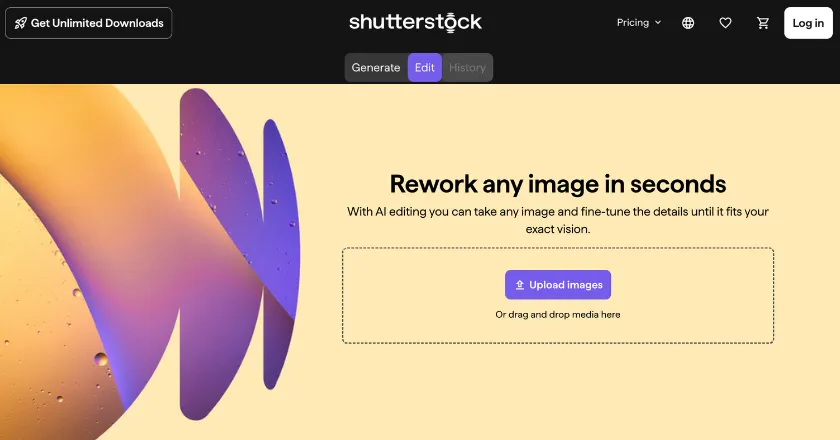
Together, the two approaches create a faster starting point. Instead of beginning with production, teams begin with adaptation.
Performance marketing has also increased the importance of creative experimentation.
Teams may want to compare several subjects, compositions, backgrounds or visual tones before deciding which version deserves the largest budget.
Historically, each additional variation cost time and money.
AI changes that.
More variants can be produced and evaluated without creating a completely new production for every test. Teams can explore alternatives earlier and learn faster from actual campaign performance.
Professional stock libraries make this process even more practical by providing a wide range of related visual options.
A testing program might compare:
The objective is not to flood the campaign with content. It is to identify stronger creative directions more efficiently.
Digital campaigns also need regular visual renewal.
An ad that performs well at launch may gradually lose impact as users become familiar with it. This forces teams to introduce new creative even when the core message remains unchanged.
Starting from zero every time would be inefficient.
Instead, brands can create visual families: groups of assets that share a common creative language but offer enough variation to keep the campaign fresh.
A family might share the same lighting style, subject matter, composition or color treatment while rotating individual images or layouts.
This approach is particularly compatible with professional stock media.
Teams can select related content and then use AI-assisted tools to produce platform-specific or performance-driven variations.
The result is more creative diversity without sacrificing identity.
International marketing creates an even greater need for adaptable visual content.
The same campaign may need different executions for Europe, Asia, Latin America and North America. Local audiences may respond better to different people, environments or cultural cues, while the overall brand expression still needs to remain consistent.
Custom production for every market can be expensive and slow.
Completely independent AI generation can be faster but may create a different challenge: visual fragmentation.
Professional stock libraries offer a useful bridge.
Global teams can select images relevant to local markets while keeping the broader campaign style intact. AI-assisted editing can then help with adaptation across formats, languages and channels.
Large collections such as Shutterstock’s are well suited to this model because they allow marketers to source content across different geographies and contexts without rebuilding the campaign for every region.
The rise of AI doesn’t mean creative professionals are becoming obsolete; rather, it shifts their focus toward how they spend their time.

In reality, the nature of their work may simply change.
Designers may spend less time on routine adaptation and more time refining visual communication. Art directors can evaluate more possibilities before committing to one direction. Performance marketers can test more hypotheses. Brand teams can spend more attention on consistency.
These are higher-value activities.
AI can make production faster, but it does not automatically know which image fits a brand, which visual feels authentic or which concept is strategically appropriate.
The availability of more options can actually increase the importance of human judgment.
No editing tool can completely remove the importance of strong source material.
Professional photography still brings deliberate composition, controlled lighting, technical execution and authentic settings. Professionally produced illustration and video offer the same advantage: they begin with intentional creative decisions.
AI can extend those assets, but the quality of the starting point still matters.
This is one reason professional stock media remains valuable. A strong source asset can reduce the amount of correction and reconstruction required later.
For creative teams, the relevant question is therefore not whether AI can create an image from scratch. It is which workflow gets to the strongest result fastest.
Sometimes generation will be the most effective route. In other cases, a high-quality existing asset may already provide most of what is needed.
Producing more content does not automatically improve marketing.
Without clear visual rules, higher output can quickly create inconsistency.
Several team members using different AI tools may unintentionally create completely different aesthetics for the same brand. One person produces polished corporate photography, another cinematic imagery, another minimal illustrations.
All three may look professional. Together, they may not look like one company.
As output increases, creative discipline therefore becomes increasingly important.
Professional source libraries such as Shutterstock can help teams establish boundaries. A brand can define a visual family and then use AI to create variation within that system. The technology becomes a scaling mechanism rather than a source of visual fragmentation.
Commercial creativity has traditionally celebrated the idea of starting from nothing.
That assumption deserves reconsideration.
Marketing is judged on effectiveness, not on the number of production steps involved. If a strong existing asset already provides the right subject, composition and emotional tone, recreating those elements from the beginning may add little value.
The more efficient approach is to preserve creative effort for the areas where it matters.
That means choosing the strongest source material available, adapting it intelligently and focusing human attention on the decisions that make the campaign distinctive.
The future of creative production is unlikely to belong exclusively to generated content, stock libraries or traditional production.
It will increasingly combine all three.
Professional photography, illustration and video provide strong source material. Stock platforms make that material accessible at scale. AI makes it easier to modify, test and reuse. Human creative professionals provide direction and judgment.
Shutterstock fits naturally into this environment because its value can extend beyond delivering a finished image. A professional visual library can become part of the production infrastructure itself, supplying source material for campaigns that are subsequently adapted and expanded through AI-assisted workflows.
The largest productivity gain may therefore not come from replacing traditional creative work altogether.
It may come from recognizing that much of the work never needed to be recreated in the first place.
Note: This article was created with the help of AI. The images in this article were generated using AI.
THE AUTHOR
Christian Fischer
Artificial intelligence has changed the speed at which marketing teams can produce visual ideas. Campaign concepts can now be explored in minutes, multiple versions can be created almost instantly, and designers can test directions that once required far more manual effort. For organizations under constant pressure to publish more content across more channels, this is […]

B2B marketing has changed a lot in recent years. Attention spans are shorter, and expectations are higher. Businesses are not only competing with their offers, but also with how clearly they present them. Visual content, especially video, has become more important across channels. Still, not all content delivers the same results. Understanding what tends to work […]
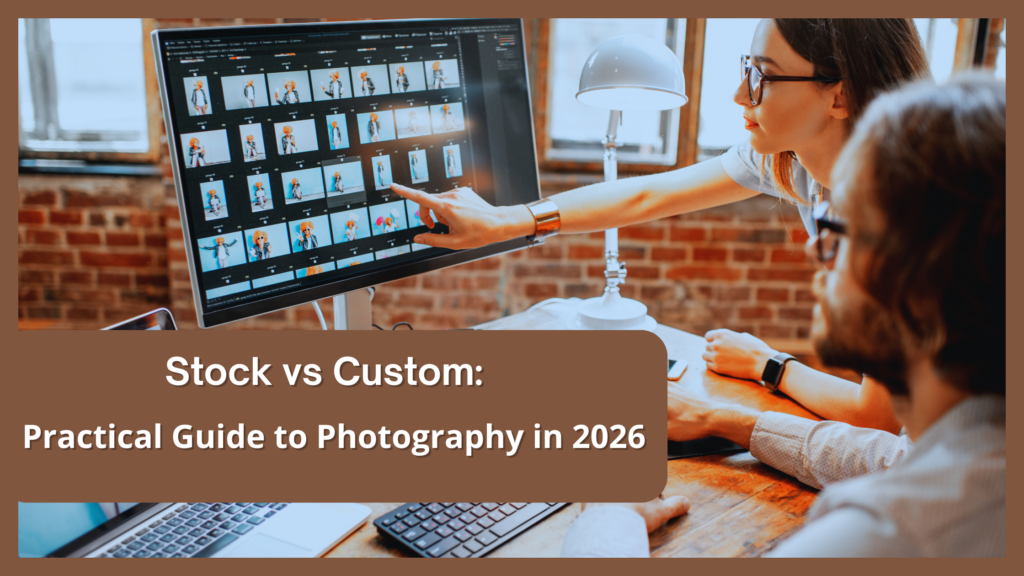
Marketing has evolved into a constant flow of content. Brands are no longer producing visuals occasionally—they are producing them continuously. This shift has transformed how businesses approach imagery. What used to be a simple choice between stock photos and custom photography has become a strategic decision tied to performance, scalability, and speed. Both options have distinct strengths, and […]